Léon Arthur Tutundjian
Signed lower right
Available
INQUIRY
Léon Arthur Tutundjian (1905 -1968)
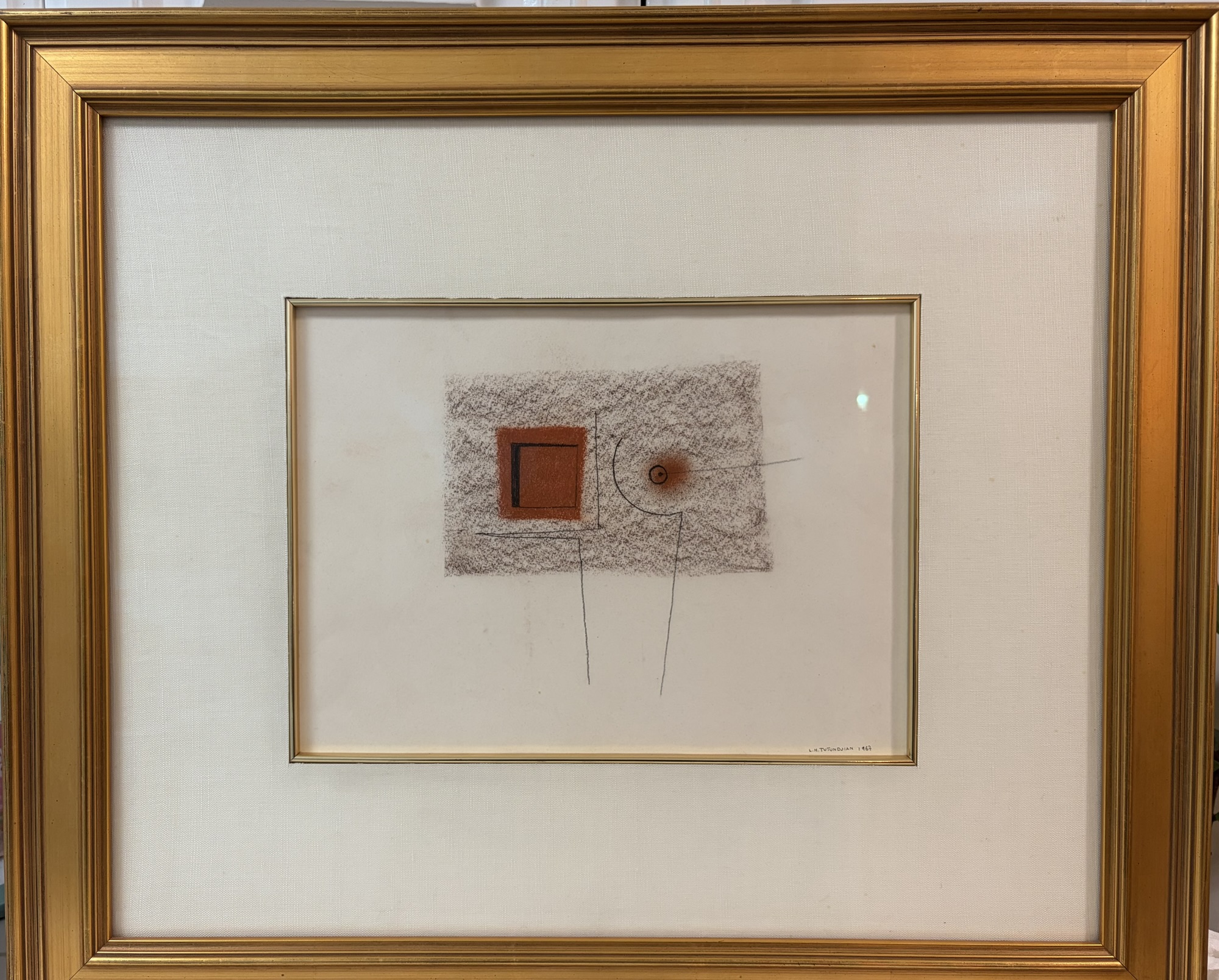
Léon Arthur Tutundjian
Léon Arthur Tutundjian (1905–1968) was an Armenian-born artist whose journey across continents and artistic movements shaped a singular, poetic visual language. Born in Amasya in the late Ottoman period, he survived the traumas of forced migration and loss before arriving in Paris in the early 1920s, where he would spend much of his life.
From his earliest work, Tutundjian displayed a restless hybrid sensibility — oscillating between crystalline geometric abstraction and a more surreal, biomorphic imagination. In the late 1920s and early 1930s, he created “reliefs,” sculptural wall-pieces of wood, metal rods, and rings, experiments that remain among his most striking contributions to European abstraction. Over time, he moved into more dreamlike, fluid compositions, exploring cosmic, organic, and psychological themes.
Throughout his career, Tutundjian’s art was informed by his early immersion in scientific ideas and musical sensibilities: structure, rhythm, harmony, and exploration of space resonate across his works. Yet equally potent is the undercurrent of memory, exile, and inner necessity — a sensitivity to tension, fragility, and transformation. Although he remained on the fringes of the mainstream art market in his lifetime, his work was respected by avant-garde circles and is now increasingly recognized in retrospectives, institutional collections, and by the foundation that preserves his legacy.
Why Tutundjian Matters
Léon Tutundjian’s importance lies in the way he bridges several currents of 20th-century art — uniting scientific thought with visual poetry, abstraction with surreal imagination, and formal rigor with mystery. As an émigré artist, his personal history of displacement and exile quietly informs his art but never confines it.
His involvement with Art Concret and Abstraction-Création helped shape the language of geometric abstraction in Europe, while his later surreal period revealed how structure and dream can coexist within the same artistic vision.
In his final years, Tutundjian returned to abstraction with renewed lyricism and sensitivity, proving himself an artist constantly searching, never bound by a single school. His work continues to resonate today for its harmony of intellect and emotion — a timeless exploration of form, memory, and inner space.
For additional information, purchasing or if you have any questions,
please do not hesitate to send us an email at info@stephaniesgallery.com or call (818) 790-4905